
Vehicle Washing and Fleet Cleaning: Pressure Washing Guide
Safe vehicle and fleet washing: cars, trucks, boats, RVs, and fleets. PSI limits, soap selection, paint protection, and two-step fleet wash process.
The Core Rule: Protect the Paint
Vehicle paint is softer and more delicate than concrete or siding. Excessive pressure strips wax, removes clear coat, and can damage the base coat. Modern automotive paint is thinner than older paint—it needs gentler handling.
The goal is clean without damage. Use low pressure, proper nozzles, and protective techniques. When in doubt, wash by hand instead of pressure washing.
Key Takeaways
- Maximum 1,200-1,900 PSI for vehicle paint — Higher pressure damages clear coat and wax
- White nozzle (40°) only — Never use green, yellow, or red tips on painted surfaces
- Keep distance 18+ inches — Closer pressure concentrates force on paint
- Use quality car wash soap — Not pressure washer detergent—car wash is pH-balanced
- Two-step for fleets: wash first, then rinse second pass — Reduces damage risk and improves results
Vehicle Types and Considerations
Personal Vehicles (Cars and Trucks)
Cars and trucks have modern automotive paint designed for hand washing or soft pressure washing. The paint is relatively thin with a clear coat on top. Pressure damage to clear coat isn’t easily repaired.
Safe approach: Maximum 1,500 PSI (many recommend 1,200 PSI), white nozzle, 18+ inches distance. Use quality car wash soap with water (2-3 ounces per gallon). Pre-soak the vehicle, wash with soft brush or cloth, pressure rinse at low PSI.
Many professional car wash operators don’t use pressure washers above 1,000 PSI—they rely on chemistry (soap) and soft brushes. This produces the best results without paint damage risk.
Commercial Trucks and Fleets
Commercial vehicles take more abuse (dirt, mud, grease) than personal cars. They can tolerate slightly higher PSI but still require care.
Safe approach: 1,500-1,900 PSI maximum, white nozzle, keep distance 12-18 inches. For heavily soiled vehicles, a two-pass approach works: first pass with soap at lower pressure, second pass with rinse water. This is gentler than trying to blast dirt off in one pass.
Buses and Large Vehicles
Larger vehicles have more surface area and accumulate heavy grime. Paint durability is similar to trucks.
Safe approach: 1,500-2,000 PSI acceptable for commercial-grade paint. Use two-step wash. Work systematically from top to bottom. Don’t focus pressure on any one area—keep moving.
Boats and Marine Vessels
Boat hulls have marine paint or gel coat designed for water exposure. Salt water requires freshwater rinse after use. Pressure washing salt-water boats removes salt buildup and prevents corrosion.
Safe approach for painted hulls: 1,200-1,500 PSI maximum, white nozzle. Use freshwater rinse for salt-water boats.
Fiberglass gel coat: Can tolerate 1,500-2,000 PSI. Avoid pressure on window seals (caulking), through-hull fittings, or electrical components.
Wooden boats: 500-1,000 PSI maximum, white nozzle. Work with the grain. After cleaning, consider wood sealant application.
RVs and Travel Trailers
RVs have thin metal siding (often aluminum), rubber seals, windows, and delicate fixtures. Water intrusion is a serious risk. Excessive pressure forces water behind siding.
Safe approach: 1,200-1,500 PSI maximum, white nozzle, never spray upward. Work from bottom to top with soap, rinse from top to bottom. Avoid directing pressure at windows, door seals, roof seams, or vents.
For stubborn stains, apply chemical cleaner (RV-specific products or dilute household cleaner), let dwell, then gently rinse. Chemistry beats pressure on RVs.
Equipment and Settings
Pressure Washer Selection
For vehicle work, you need adjustable pressure. A 2,000-2,500 PSI machine dialed down to 1,200-1,500 PSI works well. Some professional car wash operators use 1,000 PSI machines specifically because they can’t exceed safe limits.
For fleet work, 2,500-3,000 PSI machines work if you control pressure carefully. A pressure gauge and regulator help you dial in exact PSI.
Nozzles and Attachments
- White (40°): Standard vehicle nozzle. Safer than green, cleans adequately when combined with soap
- Yellow (15°): Only for stubborn stains on truck beds or bumpers, not painted surfaces
- Green or red: Never on vehicles—excessive pressure risk
- Foam cannon or downstream injector: Applies pre-soak soap for gentle initial cleaning
A foam cannon applies soapy water at the start—this pre-soaks the vehicle, allowing dirt to loosen before pressure rinsing. This is gentler and often more effective than high-pressure blasting.
Cleaning Equipment
A soft brush or microfiber cloth is useful for hand washing or agitating stubborn spots. Pressure wash alone won’t remove heavy mud or road film without aggressive force—use chemistry and brushing instead.
Soap and Chemical Selection
Car Wash Soap
Use pH-balanced car wash soap, not pressure washer detergent. Car wash soap is formulated to be gentle on paint, wax, and clear coat. Pressure washer detergent is harsher and can strip protective coatings.
Dilute at 2-3 ounces per gallon of water for general washing. Heavy grime may need slightly stronger mix (up to 4 ounces per gallon).
Fleet Wash Detergents
Commercial fleet detergents are stronger than personal car wash soap because fleet vehicles are dirtier. They remove road salt, road film, and grease more effectively. Use per manufacturer directions, usually 3-5 ounces per gallon.
Degreaser for Trucks
Trucks accumulate grease and oil, especially undercarriage. A separate degreaser pass helps. Apply degreaser to heavily soiled areas, let it dwell 5-10 minutes, then pressure rinse with white nozzle at low PSI.
Salt-Water Rinse Concerns
If washing marine vehicles in areas with salt water, use a freshwater rinse after cleaning. Salt residue accelerates corrosion. Some marinas provide freshwater rinse stations specifically for this reason.
Vehicle Cleaning Process
Personal Vehicles
Pre-soak: Apply car wash soap with foam cannon or dilute solution with garden hose and brush attachment. Work from top to bottom. Let soapy water dwell 5-10 minutes.
Agitation: Use soft brush on heavily soiled areas (wheels, lower body, undercarriage). This is gentler than pressure for heavy dirt.
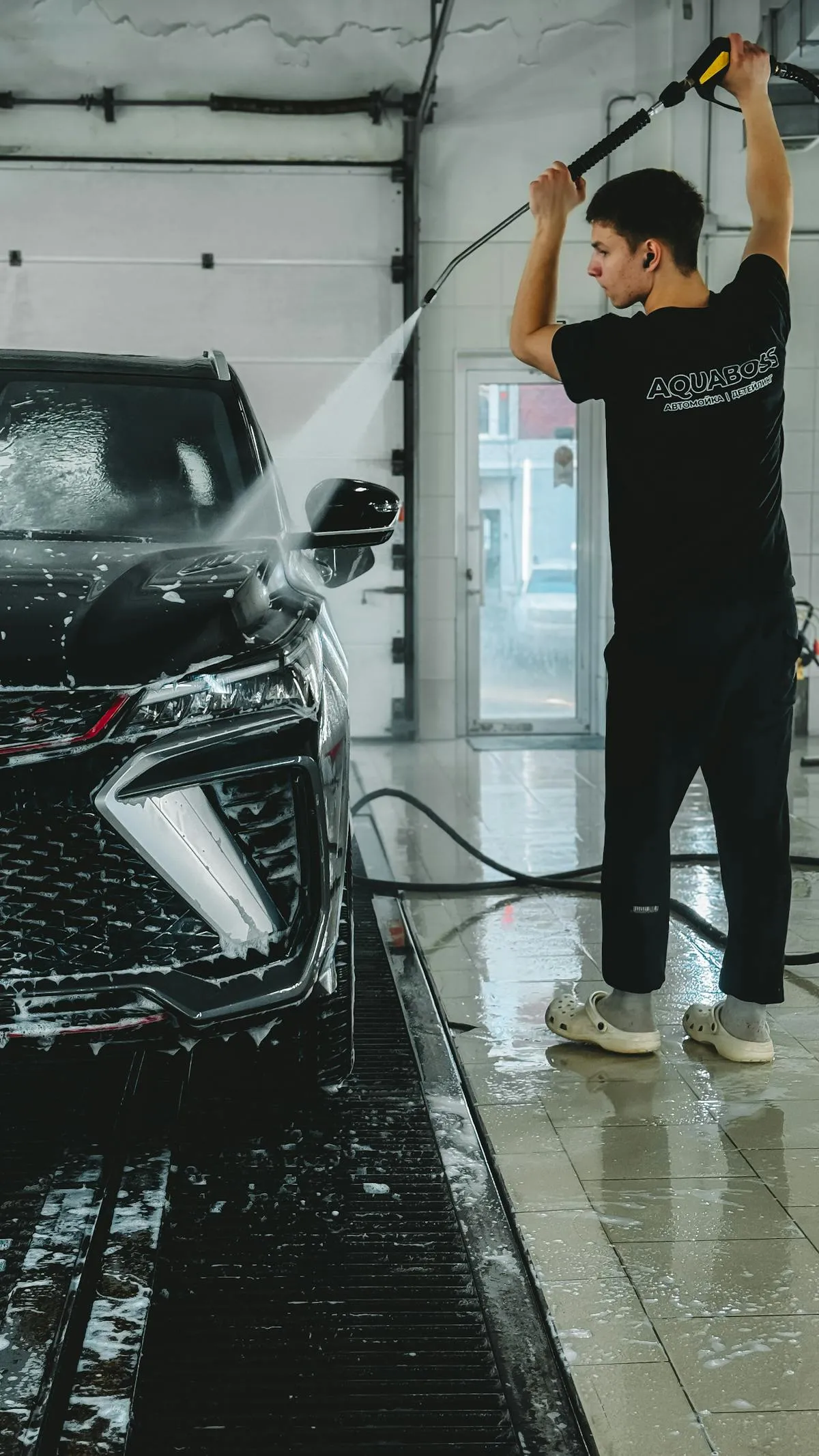
First rinse: Pressure rinse at 1,200-1,500 PSI with white nozzle. Start from top, work downward. Hold distance 18+ inches. Keep the wand moving—never focus on one spot.
Detail rinse: Use lower PSI (1,000 PSI or less) for final detail areas like windows, mirrors, and trim.
Final touch: Some detailers apply a quick spray wax after rinsing for finish and protection.
Fleet Vehicles (Two-Step Wash)
The two-step approach is industry standard for heavy commercial cleaning:
First Pass (Wash):
- Apply fleet wash detergent at lower pressure (1,000-1,200 PSI) from top to bottom
- Work in sections—hood, sides, back, undercarriage
- Let detergent dwell 5-10 minutes, especially on heavily soiled areas
- Use soft brush on wheels, bumpers, and road film areas
- Don’t rinse yet—detergent is still working
Second Pass (Rinse):
- Increase pressure to 1,500-1,900 PSI if needed (more powerful for effective rinsing)
- Rinse from top to bottom to carry away all detergent
- Work systematically—don’t miss spots
- Pay special attention to trim, crevices, and undercarriage where detergent residue collects
- Final low-pressure pass for detail areas
This approach is gentler on paint than high-pressure single-pass washing while achieving better results.
Boats
Pre-wash:
- Rinse loose salt and debris with freshwater
- Apply marine cleaner from top to bottom
- Dwell 10 minutes
Wash:
- Use soft brush on stubborn spots
- Pressure rinse at 1,500 PSI maximum, white nozzle
- Start at top, work downward
- Avoid windows, seals, and fitting areas
Post-wash:
- Final freshwater rinse to remove all salt and cleaner
- Allow to air dry or hand-dry to prevent water spots
RVs
Pre-wash:
- Rinse with garden hose to remove loose dirt
- Apply RV-specific cleaner or dilute degreaser
- Let dwell 5-10 minutes
Wash:
- Use soft brush on heavily soiled areas
- Pressure rinse at 1,200 PSI maximum, white nozzle
- Work from bottom to top with soap, then top to bottom for rinse
- Avoid spraying upward (water intrusion risk)
Post-wash:
- Check windows, door seals, and roof for remaining water
- Allow to dry completely before covering or traveling
- If water intrusion occurs, address immediately
Areas Requiring Special Care
Windows and Glass
Water gets trapped under window trim. Use low pressure (500-1,000 PSI) around windows, or hand wash with soft cloth. Don’t spray directly into the window frame.
Door Seals and Weather Stripping
These protect against water intrusion. Use low pressure or hand wash. Water forced behind seals causes mold and corrosion.
Wheels and Tires
Wheels handle higher pressure (up to 2,000 PSI) because they’re not painted with automotive paint. Tires are rubber and very durable. Use more aggressive pressure (or even a rotary brush) on wheels.
Undercarriage
This area accumulates road salt, grime, and mud. Heavy cleaning here is important for rust prevention. Use 1,500-2,000 PSI with white nozzle, but avoid spraying directly at suspension components or electrical areas.
Engine Bay
Use very low pressure (500-1,000 PSI) or hand wash with soft brush. Water entering the engine can damage electronics. Avoid high pressure near battery, alternator, or electrical components.
Fleet Washing Operations
Setup and Process
For fleet operations:
Establish a wash station: Concrete or asphalt area with drainage. Arrange vehicles in a line for efficiency.
Pre-organize chemicals: Mix detergent in the right concentrations. Have dilute solutions ready for different vehicle types.
Systematic approach: Wash one vehicle at a time from top to bottom. Two-step (wash, then rinse) is more efficient than trying to wash everything at once.
Time management: Plan workflow to minimize idle time. For 10-vehicle fleets, allow 4-6 hours total (30-45 minutes per vehicle).
Quality control: Inspect each vehicle before and after. Document that it was washed. Address any damage concerns immediately.
Cost Management
Fleet washing costs less per vehicle when done in batches (chemical mix efficiency, time savings). Typical commercial fleet wash costs $15-30 per light vehicle, $20-40 per truck, depending on contamination and operator experience.
DIY fleet washing costs $100-200 in chemicals and water for 10 vehicles (very economical for commercial operations).
Frequency
Most commercial fleets need monthly to quarterly washing depending on environment. High-salt areas (coastal, winter road salt) need monthly. Low-contamination areas might go quarterly.
Common Problems and Solutions
Paint Damage (Etching or Haze)
This happens with excessive pressure or aggressive nozzles. Apply clay bar treatment to affected area (removes etching), then apply polish and wax. Prevention is better—use lower PSI.
Water Spots
Hard water minerals left after rinsing. Use distilled water for final rinse, or apply spot remover chemical. In high-hard-water areas, use softened water if available.
Salt Residue
Saltwater vehicles not thoroughly rinsed. Freshwater rinse after salt-water exposure removes salt. Repeat rinses may be needed in high-salt environments.
Damage to Trim or Caulking
Excessive pressure damages rubber seals, caulking, trim pieces. Use lower pressure, or hand wash these areas. Caulking replacement is expensive—avoid blasting it with pressure.
Water Getting Behind Doors or Windows
Improper spraying technique (upward or direct into seams). Use downward angled spray, lower pressure, or hand wash around doors and windows. If water intrusion occurs, dry the vehicle immediately and allow interior air circulation.
When to Use Professional Fleet Washing
Commercial fleet washing services handle large fleets efficiently. Reasons to outsource:
- Volume: 20+ vehicles becomes time-intensive
- Efficiency: Professionals work faster and use optimized processes
- Damage risk: Professionals know how to avoid issues
- Equipment: Professional-grade equipment and chemicals
- Time: Your staff focuses on other work
For small fleets (3-5 vehicles), DIY is often cost-effective. For larger fleets, professional service may be justified.
Next Steps
Was this article helpful?
Your feedback helps us improve our content.
Related Articles

Boat and Marine Vessel Washing: Complete Guide
Wash boats and marine vessels safely removing salt and marine growth without damaging gel coat or hull. Proper pressure, hull safety, and environmental regulations for marine cleaning.

Fleet Washing: Semi-Trucks, Buses, and Heavy Equipment
Professional fleet washing techniques for semi-trucks, buses, and heavy equipment. Learn proper pressure washing methods, regulatory compliance, and wastewater recovery systems.
The Two-Step Fleet Wash Process: Acid and Alkaline
Master the two-step fleet wash process using alkaline pre-soak and acid brightener. Learn proper acid/alkaline balance, aluminum safety, and professional brightening techniques.