Pressure Washing Equipment Guide: Types, Features, and What to Buy
Complete guide to pressure washing equipment: gas vs electric, PSI/GPM explained, must-have features, and how to choose the right machine.
- Gas = Power and Portability, Electric = Affordability and Ease of Use
- Cleaning Units (CU) = PSI × GPM — This is your true cleaning power
- Residential standard: 2,500-3,000 PSI, 2.3-2.5 GPM (5,750-7,500 CU)
- Must-have features: Adjustable nozzle, detergent tank, onboard storage
- Budget-friendly doesn't mean cheap — Prioritize CU over fancy features
Understanding pressure washer types
Electric pressure washers
Electric washers are the entry point. They’re quieter, lighter, and need far less maintenance than gas. No oil changes, no spark plugs, no fuel gumming up the system. That simplicity is their main appeal.
Pros:
- Quiet enough to hold a conversation
- Lightweight—usually 20-35 lbs, manageable for extended use
- Zero maintenance: no oil changes, no pull-cord starts
- No exhaust emissions during operation
- Compact for easier storage
Real limitations:
- Lower power—typically 1,500-2,000 PSI, 1.2-1.5 GPM
- Tethered to an outlet (extension cords become necessary)
- Pump life is shorter—50-100 hours before noticeable performance decline
- Limited reach and mobility. Cord management becomes constant
Best for:
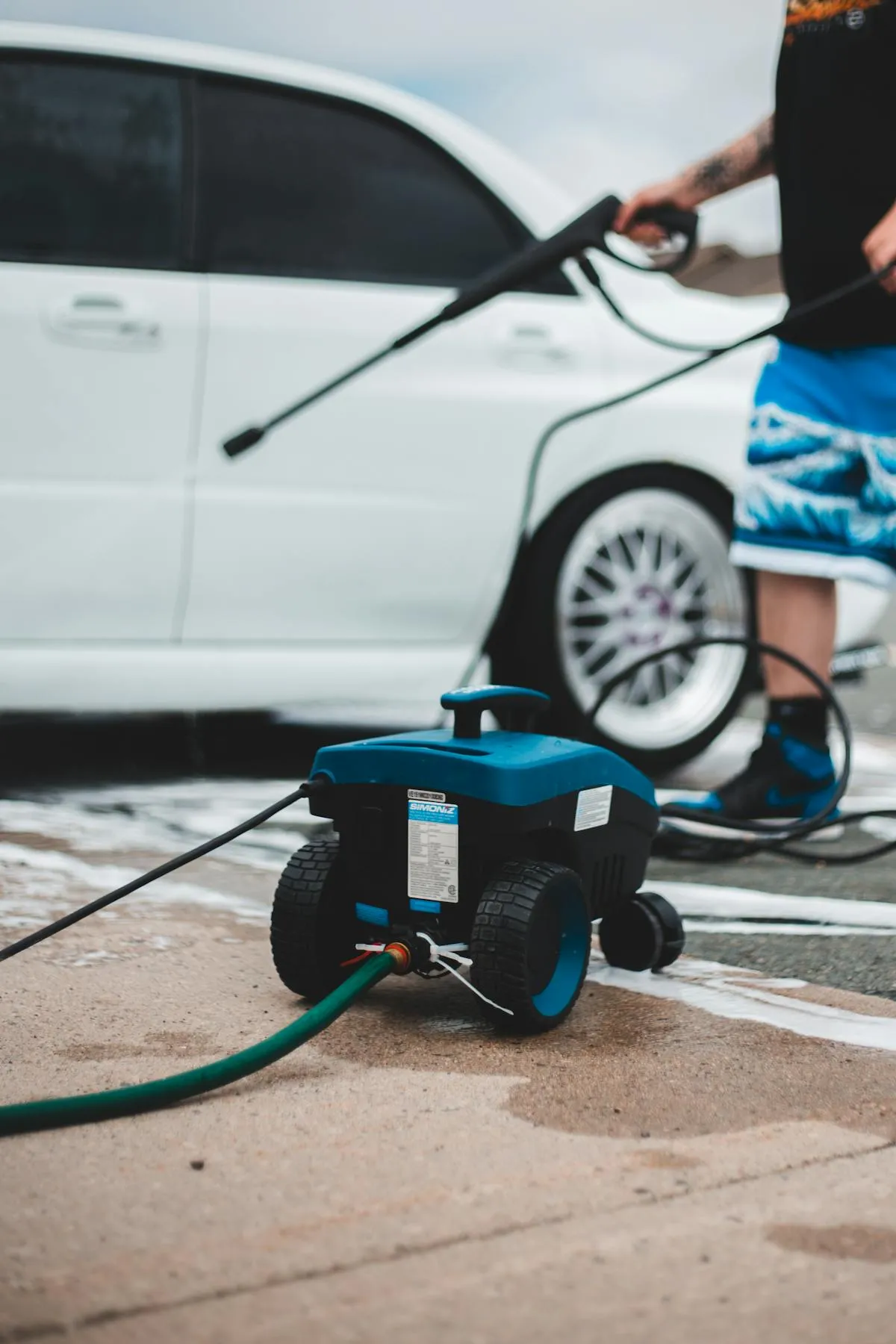
- Occasional homeowners cleaning cars or small patios
- Light deck cleaning or patio work
- Anyone prioritizing simplicity over power
- Budget-conscious buyers ($150-$300 range)
Electric models at a glance:
Light duty (cars, furniture): 1,500-1,800 PSI, 1.2-1.5 GPM = 1,800-2,700 CU | $150-$250
Medium duty (decks, patios): 2,000-2,300 PSI, 1.5-2.0 GPM = 3,000-4,600 CU | $250-$400
Gas pressure washers
Gas machines are the workhorses. More power, superior durability, zero cord restrictions. They’re louder and require actual maintenance, but for anything beyond light work, they deliver results.
Real advantages:
- Serious power—2,500-4,000+ PSI with meaningful flow (2.3-3.5+ GPM)
- Fully portable. No outlet hunting or extension cord management
- Quality pumps last 300-500+ hours
- Faster cleaning across multiple jobs
- Can be used anywhere
Real drawbacks:
- Loud—no holding a conversation nearby
- Heavy—50-90 lbs, which compounds over time
- Maintenance required: oil changes, spark plug inspection, air filter cleaning
- Exhaust and emissions
- Higher upfront cost—$300-$2,000+ depending on model
Best for:
- Weekly or frequent users
- Anyone cleaning entire driveways, large decks, or full houses
- Properties without convenient power access
- Those planning to generate income with the equipment
Gas models at a glance:
Residential standard — The common starting point. 2,500-3,000 PSI, 2.3-2.5 GPM = 5,750-7,500 CU | $300-$600 Handles driveways, decks, houses. Sweet spot for most homeowners.
Prosumer/Heavy-duty — For regular, demanding use. 3,200-4,000 PSI, 2.5-3.5 GPM = 8,000-14,000 CU | $600-$1,200 Large properties, tough stains, faster work. Builders and serious homeowners.
Commercial grade — Professional territory. 4,000-5,000+ PSI, 4.0-8.0 GPM = 16,000-40,000+ CU | $1,500-$5,000+ Built for daily use. Contractors, industrial cleaning, high-volume work.
The numbers: PSI, GPM, and CU
PSI (pounds per square inch)
PSI measures pressure—how hard the water hits the surface. It matters, but it’s only half the story.
More PSI tackles tougher stains and cuts through harder buildup. The trade-off: excessive PSI destroys surfaces. Concrete damage, stripped wood siding, and gouged decking happen fast with wrong pressure selection. The machine won’t discriminate.
Common PSI ranges:
- 1,500-2,000: Light work—cars, furniture, delicate surfaces
- 2,500-3,000: Most residential jobs—decks, driveways, painted surfaces
- 3,200-4,000: Heavy work—industrial concrete, thick algae, commercial stains
- 4,000+: Professional territory—specialized industrial work
Higher isn’t always better. You want enough PSI for the job, not maximum PSI. Surface damage is irreversible.
Pro Tip: Start with lower pressure and test on inconspicuous areas first. Increase gradually. Pressure damage happens in seconds.
GPM (gallons per minute)
GPM is flow rate, meaning how much water the machine pumps out. This is where real cleaning power lives, not in PSI alone.
PSI is force, but GPM is volume. You can have all the force in the world, but a trickle won’t move dirt effectively. More water sweeps grime away faster. GPM gets less attention than PSI, but it matters just as much.
Typical GPM ranges:
- 1.2-1.5: Electric equipment, light duty work
- 2.0-2.5: Residential gas units
- 3.0-4.0: Contractor and prosumer machines
- 4.0+: Commercial and industrial setups
GPM directly affects job speed. Two machines with identical PSI but different GPM will clean at different rates. Higher flow always wins.
Cleaning units (CU)
This is the number that actually tells you what a machine can do: CU = PSI × GPM
When comparing machines, look at CU instead of PSI specs. It’s the only honest measure because it factors in both pressure and flow. A high-PSI machine with weak flow gets outperformed by lower-PSI equipment with good flow. CU cuts through marketing noise. Use our cleaning unit calculator to compare any machines you’re considering.
CU ranges:
- 2,000-3,000 CU: Light work
- 4,000-6,000 CU: Medium duty
- 6,000-9,000 CU: Heavy residential jobs
- 10,000-15,000 CU: Professional work
- 20,000+ CU: Commercial and industrial
Why it matters—real example:
Machine A: 2,000 PSI × 2.0 GPM = 4,000 CU Machine B: 3,000 PSI × 1.5 GPM = 4,500 CU
Machine B cleans faster despite lower PSI because higher CU means more real-world cleaning power. PSI and GPM work together. One without the other is just specs on a box.
Essential features to look for
Non-negotiables
Adjustable nozzles or pressure control. Different surfaces need different pressure. You need at least three nozzles: white (40 degrees), green (25 degrees), and black/soap (65 degrees) tips. This isn’t optional.
Detergent system. Either a built-in tank or downstream injector. Chemical cleaning delivers results pressure alone can’t achieve. Look for adjustable injection ratio when possible.
Safety features that actually work. A trigger safety latch (prevents accidental spray), total stop system (motor shuts down when you release the trigger), thermal relief (prevents pump overheating), and low-oil shutdown on gas models. These prevent injuries and machine failure.
Warranty. Pressure washers fail. Repairs cost money. Minimum one year, but two to three years is what you want. Extended warranty options are worth examining for expensive machines.
Avoid These Purchase Mistakes: Buying based on PSI alone without checking GPM. Choosing the largest machine you can afford instead of sizing for actual needs. Skipping the warranty. These choices lead to underpowered equipment, frustration, or expensive repairs.
Worth considering
Onboard storage. Hose reel, nozzle storage, tool holders. These keep equipment organized and prevent loss. Not essential, but valuable for regular use.
Adjustable pressure regulator. Fine-tune pressure on the fly. Saves nozzle swaps and reduces damage risk.
Turbo or rotary nozzle. Spinning 0° tip creating a circular pattern. Blasts through flat surfaces fast. Warning: can damage surfaces if misused.
Surface cleaner attachment. Housing with spinning nozzles underneath. Cleans driveways and patios evenly and quickly without stripes. Becomes essential once experienced.
Extension wand. Adds 6 to 24 feet of reach depending on model. Gets you to second stories without ladder climbing. Clear safety advantage.
Save your money on
Pressure gauges. You don’t need exact PSI readings. If you’re worried about pressure, you shouldn’t use that nozzle.
Built-in water heaters. Hot water is specialized work—mostly commercial grease and oil cleaning. Adding $500-$1,000+ for something used twice? Not worth it.
A rainbow of spray tips. Red and yellow tips are dangerous in residential work. You’ll only use green, white, and black/soap. Don’t pay extra for unused colors.
Brands that stick around
Electric equipment
Sun Joe — Budget option. $100-$300. Works for occasional use and small jobs. Two-year warranty. Good value for light work.
Greenworks — Solid mid-range choice. $150-$400. More reliable than Sun Joe, better warranty (3-4 years). Good for regular use.
Ryobi — Quality build if you own other Ryobi tools. $200-$400. Three-year warranty. Nice if tool ecosystem integration matters.
Karcher — German-made, well built. $200-$500. Premium build quality, 2-3 year warranty. Worth it for durability.
Gas equipment
Generac — Reliable, solid power. $400-$900. 2-3 year warranty. Good for whole-house work and large properties.
Simpson — Premium build, actually durable. $400-$1,200. Warranty up to 5 years on frame. Semi-pro territory with solid reliability.
Briggs & Stratton — Well-established engines. $400-$800. 2-3 year warranty. A one-time purchase that lasts for years.
Honda-Powered Models — Best engines available. $600-$1,500. Warranty varies by brand, but Honda builds reliable equipment. Premium cost, premium durability.
Professional/commercial
Mi-T-M — Commercial-grade, built for daily work. $1,000-$4,000. Real contractors use these.
Landa — Heavy-duty industrial work. $1,500-$5,000. Fleet washing, stubborn jobs. Serious equipment.
Hotsy — Premium commercial. $2,000-$6,000. Industrial applications. Top tier.
Buying decision framework
Step 1: Figure out what you actually need
Start with three honest questions: What are you cleaning? How often? What’s your real budget?
The temptation is strong to buy the biggest machine you can afford. Don’t. If you’re washing cars and patio furniture, that 4,000 PSI beast is overkill and hard to manage. You’ll fight it instead of cleaning. Buy for actual needs, not for capability you won’t use.
If you’re doing light work (cars, furniture, small patio): Electric, 1,500-2,000 PSI, 1.2-1.5 GPM | $150-$250
If you’re tackling driveways, decks, fences, house washing: Gas (or high-end electric if you dislike noise), 2,500-3,000 PSI, 2.3-2.5 GPM | $350-$600
If you’ve got a large property or you’re using equipment weekly: Gas, 3,200-4,000 PSI, 2.5-3.5 GPM | $600-$1,200
If you’re thinking professional work: Commercial gas, 4,000+ PSI, 4.0+ GPM | $1,500+
Step 2: Size for your toughest job
Don’t size for what you do every week. Size for the hardest thing you’ll ever need to clean.
Quick CU reference:
- Cars and furniture: 2,000-3,000 CU
- Wood decks and fences: 4,000-6,000 CU
- Concrete driveways: 6,000-9,000 CU
- House washing: 5,000-7,500 CU
- Commercial flatwork: 10,000+ CU
You can always dial back pressure on an overpowered machine. You can’t dial up what isn’t there.
The most common mistake is undersizing. Buy for your toughest job, not your typical job. You can always reduce pressure. You can't create power that doesn't exist.
Step 3: Know where your money should go
When building a budget, prioritize like this:
- The pump — This is what actually works
- The engine or motor — This runs the pump
- CU rating — Your real cleaning power
- Essential features — Adjustable pressure, detergent, safety
- Warranty — Machines break
- Everything else — Nice to have, not essential
Safe places to cut costs:
- Fancy pressure gauges you’ll never read
- Excessive spray tips when three do the job
- Flashy paint jobs
- Deluxe frame designs
Stupid places to cut costs:
- Pump quality. A weak pump means weak results forever.
- Engine or motor reliability. A bad engine turns your machine into a paperweight.
- Safety features. These prevent injuries and catastrophic failures.
- Warranty. It’s the only safety net when things go sideways.
Cheap equipment fails faster. Mid-range equipment consistently outperforms budget models over time.
Budget for accessories too
You’ll spend 15-25% of your machine’s cost on accessories. Plan for it.
Things you’ll actually need:
- Extra nozzle tips ($20-$50), because you’ll lose them
- Extension wand ($50-$150) to reach second stories without a ladder
- Surface cleaner ($100-$300) for faster, more even driveway work
- Chemicals ($50-$150) including house wash mix, degreasers, algaecide
- Replacement O-rings ($10-$20) to prevent leaks when seals wear
Things that make life easier:
- Hose reel ($100-$200) so your hoses stay untangled
- Turbo nozzle ($40-$80) for blasting through stubborn buildup faster
- Foam cannon ($30-$60) for thick, professional-looking foam coating
- Brush attachments ($20-$50) for physical agitation on really stuck grime
Budget targets:
- Basic kit: $150-$250
- Full setup: $400-$600
Keeping it running
After every use
Flush the system with clean water for two minutes. This single task keeps your pump alive longer. Disconnect hoses and let them drain completely. Wipe everything down so grime doesn’t bake on. Check connections for leaks. Test your trigger safety to ensure it works.
This takes five minutes. Skip it and your pump fails faster.
Gas equipment needs real maintenance
Every 5 hours (or daily if using hard): Check your oil. Clean the air filter. Inspect the spark plug.
Every 50 hours (roughly monthly): Change the oil. Clean the fuel filter. Check all bolts are tight. Inspect hoses for cracks. Neglecting this leads to engine rebuild costs.
Before winter: Winterize. Add fuel stabilizer, drain the tank if storing long-term in freezing conditions. Keep it dry indoors. Frozen equipment becomes broken equipment.
Pro Maintenance Tip: Keep a maintenance log. Record every oil change, filter cleaning, and repair. This catches patterns and prevents expensive failures.
Electric equipment
Check your cord for damage before each use. Verify GFCI is working (press the test button if present). Keep connections dry. Never use wet plugs.
Once monthly, inspect pump seals and O-rings. Test pressure consistency to catch degradation early. Electric motors fail quietly, so catch problems before the machine dies.
When it’s time to upgrade
You outgrow equipment when jobs that took an hour now take three, when you can’t clean what needs cleaning, or when constant repairs become frustrating.
Red flags:
- Jobs are taking forever (undersized CU)
- You can’t remove what needs removing (insufficient power)
- Constant breakdowns (cheap equipment dying)
- You’re using it weekly or more
- You’re starting to generate income with it
Electric to Gas: Jump to 3,000 PSI / 2.5 GPM. You move from about 3,000 CU to 7,500 CU. That’s 2.5x faster cleaning. You gain portability and real power.
Residential to Prosumer: Move to 3,500-4,000 PSI / 3.0 GPM. From ~7,500 CU to 12,000 CU. 1.6x faster and far more durable.
Prosumer to Commercial: Jump to 4,000+ PSI / 4.0+ GPM. 20,000+ CU. For people doing this for a living. 1.7x faster than prosumer, built for daily use.
Next steps
Was this article helpful?
Your feedback helps us improve our content.