

Wood Staining Guide for Pressure Washing Professionals: Upsell Service, Prep, Products, and Pricing
Guide to offering wood staining as an upsell service for pressure washers. Covers prep requirements after washing, product selection, application methods, pricing stain jobs, and common mistakes.
The Opportunity
After you pressure wash a deck or fence, the wood looks great. Customer looks at it and thinks: “This could look even better with stain.”
That’s an upsell.
Washing a deck: $200-400. Staining that same deck: $400-800. Same customer, one job site, minimal additional equipment. This is easy profit growth.
Why Staining Matters
For customers:
- Protects wood from UV damage (prevents graying)
- Protects from water damage and rot
- Looks good (main reason)
- Extends deck/fence life by 5+ years
- Increases home value perception
For you:
- Higher profit margin than pressure washing alone
- Justifies the site visit (fixed cost already covered)
- Builds customer loyalty (more comprehensive service)
- Repeat business (stain lasts 2-4 years, needs reapplication)
- Easier than new customer acquisition
Part 1: Prep Requirements After Washing
Staining fails if prep is wrong. This is non-negotiable.
Pre-Wash Assessment
Before you pressure wash, identify:
- Old stain present? (You need to strip it)
- Paint present? (You need to strip it)
- Sealant present? (Matters for compatibility)
- Wood type? (Some stains aren't compatible with all wood)
- Wood condition? (Rot, splinters, exposed fasteners)
Talk to customer before starting: “I’ll pressure wash this, and the wood will be ready for stain. We can apply stain in 24-48 hours if you want the full package.”
Pressure Washing For Stain Prep
Different from regular wash:
- Use lower PSI (1500-2000 max)
- Use white nozzle (40° angle, gentler)
- Goal: Remove dirt and algae, NOT strip the surface
- You want a clean surface, not a raw surface
Do NOT:
- Strip existing stain aggressively
- Blast the wood to bare wood (unless customer specifically wants stripping)
- Use high PSI on softwoods (pine, fir)
Why this matters: Light surface prep allows old stain remnants + new stain to bond together. Over-washing can require extra prep work (sanding).
Time Between Wash and Stain
Critical timing issue:
- Too soon (under 24 hours): Wood is still wet. Stain won't adhere. Disaster.
- Perfect timing (24-48 hours): Wood is dry, surface moisture gone, stain adheres properly
- Too late (over 7 days): New algae/dirt starting, surface starts oxidizing, stain prep degraded
Best practice: Schedule stain for 24-48 hours after washing. This gives you time to coordinate, and wood to dry fully.
Wood Moisture Check
Before applying stain:
- Use a moisture meter (cheap, $20-40 from home improvement store)
- Ideal moisture: 12-17% for most stains
- If over 20%: Wood is too wet. Wait longer.
- If under 10%: Wood may be too dry (rare). No problem, proceed.
Without a moisture meter:
- Touch the wood — should feel dry, not cool/damp
- In humid climates, allow 3-5 days after washing
- In arid climates, 24 hours usually enough
Light Sanding or Brushing
Before stain application:
- Brush with stiff brush to remove loose particles
- Light sand with 120-150 grit if needed (only if customers wants ultra-smooth finish)
- Vacuum or blow off dust completely
- Wipe with damp cloth, let dry
- Time: 30 minutes to 1 hour
Why: Stain adheres better to smooth surface. Loose particles get trapped under stain.
Part 2: Product Selection
Stain Types
Solid Stain (Paint-like coverage):
- Blocks 100% of UV light
- Thickest coverage (like paint)
- Hides wood grain completely
- Lasts 4-6 years typically
- Cost: $30-50/gallon
- Coverage: 200-300 sq ft per gallon
- Best for: Customers who want color, less maintenance
Semi-Transparent Stain (Most popular):
- Blocks 70-80% of UV light
- Shows wood grain
- Medium thickness
- Lasts 2-3 years typically
- Cost: $25-40/gallon
- Coverage: 300-400 sq ft per gallon
- Best for: Most customers (best balance of beauty and durability)
Transparent Stain (Thin):
- Blocks 30-50% of UV light
- Shows wood grain completely
- Thin application
- Lasts 1-2 years typically
- Cost: $20-30/gallon
- Coverage: 400-500 sq ft per gallon
- Best for: Protection only (minimal color change)
Oil-Based vs Water-Based
Oil-Based (Traditional):
- Deeper, more saturated color
- Better penetration into wood
- Longer dry time (24-48 hours)
- Stronger smell (linseed oil, etc.)
- Environmental concerns (some states restricting)
- Slightly more durable
- Cost: $30-60/gallon
Water-Based (Modern):
- Low VOC (environmentally friendly)
- Fast dry time (4-8 hours)
- Low odor
- Easier cleanup
- Thinner consistency (requires more coats sometimes)
- Cost: $35-65/gallon
- Can work on damp wood (slight advantage)
Water-based stains are becoming industry standard. Faster drying = you get paid faster. Lower odor = happy neighbors. Fewer environmental restrictions = less liability.
Brand Recommendations
Proven in the field:
- Cabot: Industry standard, widely available, reliable ($30-50/gallon)
- Behr: Home Depot brand, good value, consistent quality ($25-40/gallon)
- Minwax: Good penetration, traditional choice ($25-40/gallon)
- Olympic (PPG): Professional grade, premium ($40-65/gallon)
- Sherwin-Williams Exterior: Premium, strong durability ($45-70/gallon)
Beginner choice: Start with Cabot semi-transparent. Proven, available everywhere, customers recognize the brand.
Color Selection
Most popular choices:
- Honey (light, warm) — Shows wood grain, forgiving
- Cedar (medium, reddish) — Classic look, very popular
- Dark walnut (dark brown) — Hides imperfections, looks expensive
- Ebony (black) — Bold, can hide wood grain entirely
- Clear (no color) — Protection only, shows wood's natural color
Recommendation to customers: “Bring home 3-4 samples from the store, paint them on your deck in different spots, live with them for a day in different light. Then decide.”
Part 3: Application Methods
Tools You Need
Basic set (under $50 total):
- Brush (3" natural bristles for oil-based, synthetic for water-based) — $10-15
- Roller (for large flat areas) with extension pole — $10-15
- Paint tray or bucket — $5
- Plastic sheeting (protect adjacent areas) — $5
- Painter's tape (mask off fasteners, railings) — $5
- Stir stick (stain separates, must remix) — Free from store
- Drop cloth (under your work area) — $5-10
Optional but nice:
- Sprayer (airless or HVLP) for large decks — $200-500 investment
- Deck stain applicator (mop-like tool) — $20-30
- Microfiber cloths for cleanup — $5
Application Technique
Step 1: Prep the area
- Lay plastic sheeting to protect grass, landscaping
- Tape off railings, fasteners, areas you don't want stained
- Move furniture away
- Ensure good ventilation
Step 2: Stir thoroughly
- Stain separates in can (pigment settles)
- Mix well — 2-3 minutes minimum
- Shake can if it's been sitting
- Remix every 30 minutes while applying (important!)
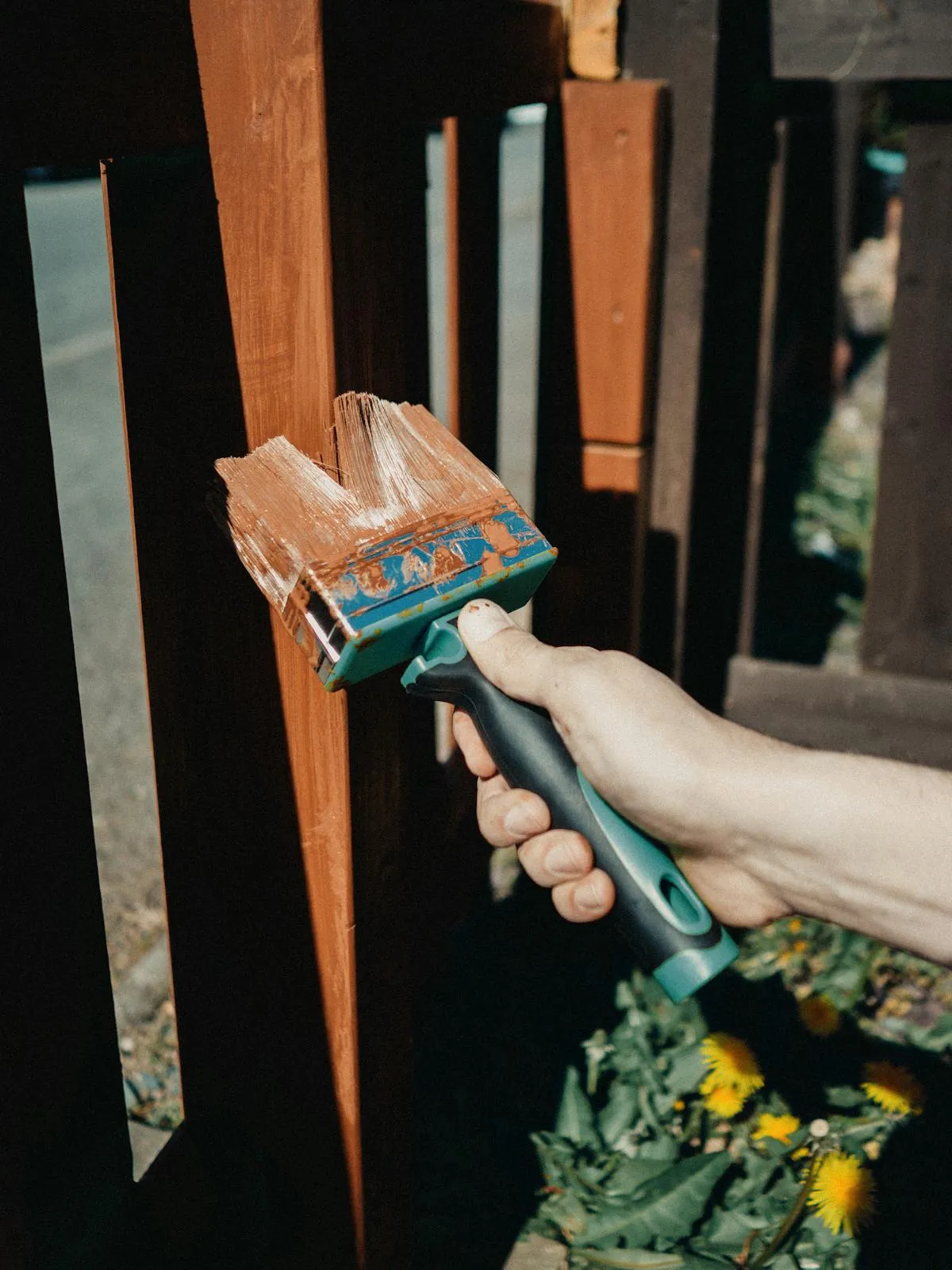
Step 3: Apply thin, even coats
- Use brush for edges and corners
- Use roller for large flat areas (faster, more even)
- Work in 4' x 8' sections
- Brush direction: With the grain (looks better)
- Overlap your strokes (avoid lap marks)
- Don't puddle stain — apply thin coat
- One thin coat is better than one thick coat
Step 4: First coat drying
- Oil-based: 24 hours before second coat
- Water-based: 4-8 hours before second coat
- Temperature matters: Cold slows drying (allow more time)
- Humidity matters: High humidity slows drying
Step 5: Second coat (usually necessary)
- Sand lightly with 150 grit if first coat is rough
- Apply second coat same way as first
- Thinner is better than thicker
- Most stains need 2 coats for full color
Step 6: Curing time
- Oil-based: 48-72 hours before use (foot traffic)
- Water-based: 24-48 hours before light use
- Tell customer: "Don't put furniture or walk on it for 3 days"
Sprayer Application (For Large Areas)
Airless sprayer method (faster for big decks):
- Setup: Connect sprayer to stain container
- Prime: Run test spray into bucket until steady
- Spray in long even strokes
- Light back-brushing behind spray to even out
- Much faster than brushing
- Requires practice to avoid drips and thin spots
Recommendation: For decks under 300 sq ft, hand application is fine. For 300+ sq ft, sprayer saves time and money.
Part 4: Pricing Stain Jobs
Cost Breakdown
Material cost per job:
- Stain: $0.05-0.15 per sq ft (depends on product and coverage)
- Supplies (brush, tape, plastic): $5-10 per job (amortized, reusable)
- Total material: $0.10-0.20 per sq ft
Labor time:
- Prep (brushing, taping): 30 min - 1 hour per job
- Application (brush): 1 hour per 200 sq ft
- Application (spray): 1 hour per 400 sq ft
- Cleanup: 30 minutes per job
- Drying/curing: Time waiting (you can do other jobs)
Pricing Models
Model 1: Per Square Foot
- Price: $0.75-1.50 per sq ft
- Example: 300 sq ft deck = $225-450
- Works for: Small and mid-size jobs
- Advantage: Easy to calculate, transparent to customer
Model 2: Per Gallon Used (Plus Labor)
- Price: Cost of gallon + $200-400 labor per gallon
- Example: Cabot semi-trans ($40) + $300 labor = $340 per gallon
- Works for: When material cost varies significantly
- Advantage: Accounts for expensive premium stains
Model 3: Flat Rate (For Standard Jobs)
- Small deck (under 200 sq ft): $150-250
- Medium deck (200-400 sq ft): $300-500
- Large deck (400+ sq ft): $600-1000
- Works for: Quick standardized jobs
- Advantage: Fast quoting, predictable for customer
Upsell Pricing (Wash + Stain Bundle)
Standard package:
- Pressure wash deck: $200-350
- Stain (separate): $250-500
- Total separate: $450-850
Bundle offer (upsell):
- Wash + stain: $550-950 (discount 10-15% vs separate)
- Saves customer money, increases your revenue
- Example: 300 sq ft deck: $300 wash + $350 stain = $650 separate → $575 bundled
Pitch to customers: “Today we wash for $300. The wood will be beautiful. For just $275 more, I can stain it and it’ll look like new for the next 3 years. That’s only $9 per month protection.”
Fence Pricing
Linear foot model (common for fencing):
- Cost: $0.50-1.50 per linear foot
- 100 ft fence: $50-150
- 250 ft fence: $125-375
- Depends on fence height and condition
Part 5: Common Mistakes and Solutions
Mistake #1: Applying stain to wet wood
Result: Stain doesn’t adhere, peeling, blotchy finish, complete failure
Fix: Moisture meter is your friend. Wait until wood reads 12-17% moisture.
Mistake #2: Only one coat of thin stain
Result: Blotchy color, uneven coverage, worse after first rain
Fix: Plan on 2 coats minimum. Semi-transparent always needs 2.
Mistake #3: Thick, heavy coats
Result: Drips, uneven finish, takes forever to dry, adhesion problems
Fix: Thin is better. Use 2-3 light coats rather than 1 heavy coat.
Mistake #4: Not mixing stain while applying
Result: Early coats darker, later coats lighter (pigment settled)
Fix: Stir every 30 minutes minimum while applying. Keep mixing.
Mistake #5: Applying stain in wrong conditions
Result: Rain washes it off, heat dries it too fast, humidity prevents drying
Fix: Check forecast. Apply in 50-85°F, low wind, no rain expected for 24 hours.
Mistake #6: Using exterior deck stain on interior wood (or vice versa)
Result: Wrong durability, potential fumes indoors
Fix: Read the can. Make sure it’s exterior-rated if for outside.
Building a Stain Repeat Business
Why customers re-stain:
- Semi-transparent lasts 2-3 years (needs reapplication)
- Customers love the results, want to maintain it
- Much easier to maintain-stain than strip and re-stain
Your system:
- Keep customer contact info
- Send email 2 years after: "Your deck is due for re-staining! Same great quality, same price."
- Re-stain jobs are faster (less prep) = higher margin
- Repeat customers are your most profitable
Bottom Line
Start simple: Semi-transparent stain, brush application, $0.75-1.25 per sq ft pricing.
Offer as upsell: Every pressure-washed deck/fence is a stain opportunity. Make it easy for customers to say yes.
Quality matters: Good stain job looks amazing. Bad stain job looks terrible. Invest in proper products and technique.
Repeat business: After 2 years, customers want re-staining. Build relationships and follow up.
High margin: Material cost under $0.20/sq ft, charge $0.75-1.25/sq ft. 75%+ gross margin beats most home service businesses.
Add staining. It’s the easiest revenue multiplier in pressure washing.
Was this article helpful?
Your feedback helps us improve our content.
Related Articles

Adding Services: Window Cleaning, Gutter Cleaning, Christmas Lights
Strategically expand your pressure washing business with window cleaning, gutter cleaning, and Christmas light installation. Learn what to add, when to add it, and how to profit.

Pressure Washing Pricing Guide: How to Price Jobs for Profit
Complete pressure washing pricing guide: calculate rates, estimate job times, factor in costs, and price for profit. Learn what pros charge.
Composite Decking Cleaning: Can You Pressure Wash Trex and TimberTech?
Complete guide to pressure washing composite decking like Trex and TimberTech: manufacturer guidelines, safe PSI levels, proper technique, and warranty considerations.